Currently Empty: $0.00
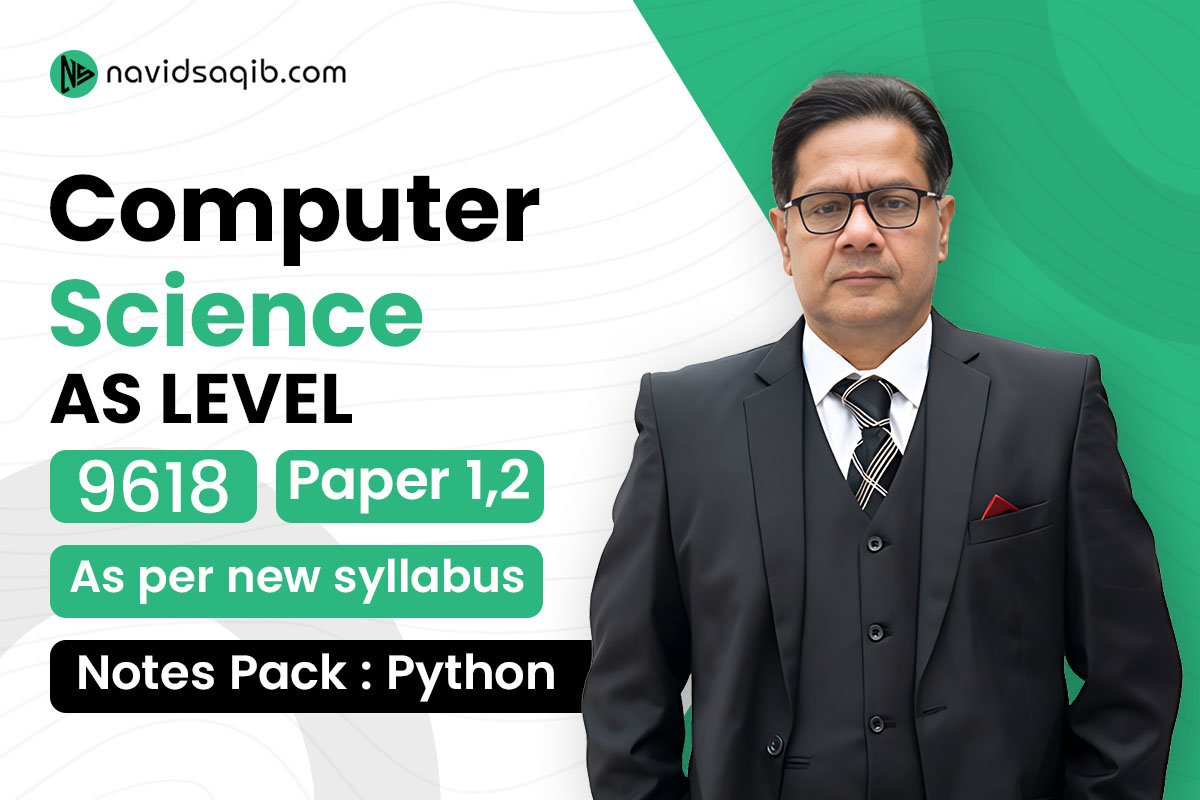
As level 9618 : Notes Pack
- By Navid Saqib
- ALevel Notes
- (0 Rating)
Cambridge AS Level Computer Science (9618)
-
The AS Level comprises two externally assessed written papers, each carrying 75 marks and constituting 50% of the AS Level (and 25% of the full A Level if continued)
-
No calculators are permitted in any paper
-
Paper 1: Theory Fundamentals
-
Duration: 1 hour 30 minutes, 75 marks.
-
Covers Sections 1–8 of the syllabus
-
-
Paper 2: Fundamental Problem-solving and Programming Skills
-
Duration: 2 hours, 75 marks.
-
Focuses on Sections 9–12, emphasising algorithmic problem solving and pseudocode
-
Sections 1–8: Theory Fundamentals (Paper 1)
-
Information Representation
-
Communication
-
Hardware
-
Logic Gates & Circuits
-
Processor Fundamentals
-
Assembly Language
-
System Software
-
Security, Privacy & Data Integrity; Ethics and Ownership; Databases
Sections 9–12: Problem-Solving & Programming (Paper 2)
-
Algorithm Design & Problem-solving
-
Data Types & Structures
-
Programming Basics
-
Software Development
Why This Course Matters
-
Holistic Foundation: Paper 1 builds critical understanding of how computers work, software systems are structured, and data is managed.
-
Skill Application: Paper 2 transitions theory into action—students practise algorithmic thinking, pseudocode, and design philosophies.
-
Progression Ready: Excellent preparation for the full A Level or university-level computing and software development courses.
Course Content
Paper 2 : Problem Solving Approach – Practical
-
9.1 Computational thinking skills
-
9.1.1 Using abstraction
-
9.1.2 Using decomposition
-
9.2 Algorithms
-
9.2.1 Writing algorithms that provide solutions to problems
-
9.2.2 Writing simple algorithms using pseudocode
-
9.2.3 Writing pseudocode from a structured English description
-
9.2.4 Writing pseudocode from a flowchart
-
9.2.5 Stepwise refinement
-
10.1 Data types and records
-
10.1.1 Data types
-
10.1.2 Records
-
10.2 Arrays
-
10.2.1 1D arrays
-
10.2.2 2D arrays
-
10.2.3 Using a linear search
-
10.2.4 Using a bubble sort
-
10.3 Files
-
10.4 Abstract data types (ADTs)
-
10.4.1 Stack operations
-
10.4.2 Queue operations
-
10.4.3 Linked list operations
-
11.1 Programming basics
-
11.1.1 Constants and variables
-
11.1.2 Library routines
-
11.2 Programming constructs
-
11.2.1 CASE and IF
-
11.2.2 Loops
-
11.3 Structured programming
-
11.3.1 Procedures
-
11.3.2 Functions
-
12.1 Program development lifecycle
-
12.1.1 The purpose of a program development lifecycle
-
12.1.2 Stages in the program development lifecycle
-
12.1.3 Different development lifecycles
-
12.2 Program design
-
12.2.1 Purpose and use of structure charts
-
12.2.2 Purpose and use of state-transition diagrams to document algorithms
-
12.3 Program testing and maintainance
-
12.3.1 Ways of avoiding and exposing faults in programs
-
12.3.2 Location, identification and correction of errors
-
12.3.3 Program testing
-
12.3.4 Program maintenance
Paper 1 : Theory Paper
-
-
-
-
1.1.3 Hexadecimal number system
-
1.1.4 Binary-coded decimal (BCD) system
-
1.1.5 ASCII codes and Unicodes
-
1.2 MultiMedia
-
1.2.1 Bit-map images
-
1.2.2 Vector graphics
-
1.2.3 Sound files
-
1.2.4 Video
-
1.3 File compression
-
1.3.1 File compression applications
-
1.3.2 General methods of compressing files
-
2.1 Networking
-
2.1.1 Networking devices
-
2.1.2 Client-server and peer-to-peer networking models
-
2.1.3 Network topologies
-
2.1.4 Public and private cloud computing
-
2.1.5 Wired and wireless networking
-
2.1.6 Hardware requirements of networks
-
2.1.7 Ethernet
-
2.1.8 Bit streaming
-
2.2 The internet
-
2.2.1 The differences between the internet and the World Wide Web
-
2.2.2 Hardware and software needed to support the internet
-
2.2.3 IP addresses
-
2.2.4 Uniform resource service (URLs)
-
2.2.5 Domain name service (DNS)
-
2.2.6 Scripting in HTML
-
3.1 Computers and their components
-
3.1.1 Types of memory and storage
-
3.1.2 Input and output devices
-
3.2 Logic gates and logic circuits
-
3.2.1 Logic gates
-
3.2.2 Truth tables
-
3.2.3 The function of the six logic gates
-
3.2.4 Logic circuits
-
3.2.5 Logic circuits in the real world
-
3.2.6 Multi-input logic gates
-
4.1 Central processing unit (CPU) architechure
-
4.1.1 Von Neumann model
-
4.1.2 Components of the processor (CPU)
-
4.1.3 Registers
-
4.1.4 System buses
-
4.1.5 Computer ports
-
4.1.6 Fetch-execute cycle
-
4.1.7 Interrupts
-
4.2 Assembly language
-
4.2.1 Assembly language and machine code
-
4.2.2 Stages of assembly
-
4.2.3 Assembly language instructions
-
4.2.4 Addressing modes
-
4.2.5 Simple assembly language programs
-
4.3 Bit manipulation
-
4.3.1 Binary shifts
-
4.3.2 Bit manipulation used in monitoring and control
-
5.1 Operating systems
-
5.1.1 The need for an operating system
-
5.1.2 Operating system tasks
-
5.1.3 Utility software
-
5.1.4 Program libraries
-
5.2 Language translators
-
5.2.1 Translation and execution of programs
-
5.2.2 Pros and cons of compiling or interpreting a program
-
5.2.3 Partial compiling and interpreting
-
5.2.4 Integrated development environment (IDE)
-
6.1 Data security
-
6.1.1 Data privacy
-
6.1.2 Preventing data loss and restricting data access
-
6.1.3 Risks to the security of stored data
-
6.1.4 Data recovery
-
6.2 Data integrity
-
6.2.1 Validation
-
6.2.2 Verification
-
7.1 Legal, moral, ethical and cultural implications
-
7.1.1 Computer ethics
-
7.1.2 Professional ethical bodies
-
7.1.3 Impact on the public
-
7.2 Copyright issues
-
7.2.1 Software copyright and privacy
-
7.2.2 The internet and the World Wide Web (WWW)
-
7.2.3 Software licensing
-
7.3 Artificial intelligence
-
7.3.1 What is AI?
-
7.3.2 The impact of AI
-
7.3.3 The impacts of AI on society, the economy and the environment
-
8.1 Database concepts
-
8.1.1 The limitations of a file-based approach
-
8.1.2 The advantages of a relational database over a file-based approach
-
8.1.3 Relational database model terminology
-
8.1.4 Entity-relationship (E-R) diagrams
-
8.1.5 The normalisation process
-
8.2 Database management systems (DBMSs)
-
8.2.1 How a DBMS addresses the limitations of a file-based approach
-
8.2.2 The use and purpose of DBMS software tools
-
8.3 Data definition language (DDL) and data manipulation language (DML)
-
8.3.1 Industry standard methods for building and modifying a database
-
8.3.2 SQL (DDL) commands and scripts
-
8.3.3 SQL (DML) commands and scripts
Tags
A course by
Navid Saqib
Computer Science Teacher
Student Ratings & Reviews
No Review Yet
Courses You May Like
Expert
As level 9618 : Notes Pack
(0.0/ 0 Rating)
Rs2,500.00
Rs3,000.00
Duration: 1 Year Session: Notes Pack, Amount : 208 Rs per month x 12...
- 30 Lessons
- 1 Students